If you’ve ever found yourself searching phonological awareness vs phonemic awareness and wondering what the actual difference is, you’re definitely not alone. These two terms get used together all the time, and it can be hard to remember which one means what.
The good news is that once you understand the difference, it becomes much easier to plan instruction and support your struggling readers. Both skills are important, and both play a huge role in helping students become successful readers.
What Is Phonemic Awareness?
So, what is phonemic awareness?
Phonemic awareness is a student’s ability to hear and work with individual sounds in spoken words. It’s completely auditory, which means students are listening to sounds rather than looking at letters on a page.
For example, when a child can hear that the word cat is made up of the sounds /c/ /a/ /t/, they are using phonemic awareness. When they can change the /m/ in mat to /s/ and make sat, that’s phonemic awareness too.
When teachers define phonemic awareness, they often describe it as the ability to hear, isolate, blend, segment, and manipulate individual sounds. These skills become the foundation for decoding and spelling later on.
Understanding Phonological Awareness vs Phonemic Awareness
The easiest way to think about phonological awareness vs phonemic awareness is that phonemic awareness is one part of phonological awareness.
Phonological awareness includes all kinds of sound work. Students might clap syllables, identify rhyming words, listen for alliteration, or break sentences into words. Phonemic awareness narrows the focus down to individual sounds within words.
Many students develop these larger sound skills first before they begin manipulating individual phonemes. That’s why both areas deserve attention during early literacy instruction.
Phonological Awareness Activities That Work
If you’ve taught kindergarten or first grade, you’ve probably used phonological awareness activities without even realizing it. Singing rhyming songs, clapping syllables, playing beginning sound games, and blending sounds orally all help students build these important skills.
Some classroom favorites include:
- Rhyming games
- Syllable clapping activities
- Sound blending practice
- Beginning sound sorts
- Oral segmenting and blending games
The key is giving students plenty of opportunities to hear and play with sounds before expecting them to connect those sounds to print.
Phonological Awareness Games Students Actually Enjoy
One of the best things about teaching these skills is that they don’t have to feel like work. Phonological awareness games often become some of the most engaging parts of the literacy block because students are moving, listening, talking, and playing.
Once you begin teaching phonemic awareness skills regularly, one challenge becomes clear pretty quickly: finding enough meaningful practice for all of your students can be difficult.
Between planning small groups, differentiating instruction, and keeping students engaged, phonemic awareness instruction can quickly become one more thing to piece together each week.
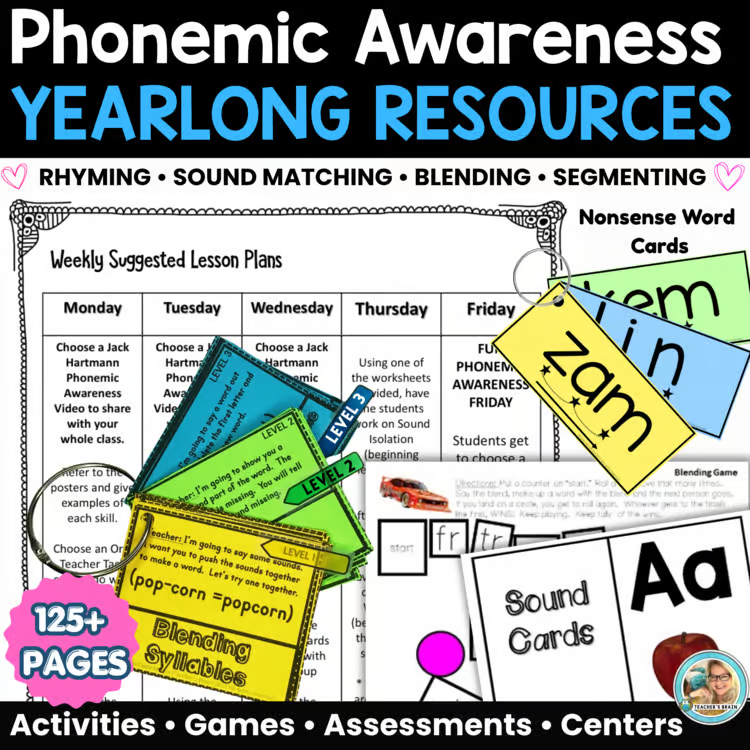
That’s why I created the Phonological & Phonemic Awareness Activities and Assessments. This yearlong resource includes more than 125 activities, assessments, games, lesson plans, and instructional materials designed to make teaching these foundational skills easier. With three levels of differentiation, teachers can support students who need extra practice while still challenging those who are ready to move ahead.
The resource covers essential skills including rhyming, syllables, beginning, medial, and ending sounds, blending, segmenting, phoneme isolation, deletion, substitution, onset and rime, and sound manipulation. It also includes progress monitoring assessments, sound cards, posters, small group activities, and hands-on games that work well during literacy centers, intervention groups, and whole-group instruction.
Whether you’re teaching kindergarten, first grade, RTI, special education, or intervention groups, having ready-to-use lessons and assessments can save valuable planning time while ensuring students receive the consistent practice they need to become confident readers.
At the end of the day, understanding the difference between phonological awareness and phonemic awareness helps us meet students where they are. When we intentionally teach these foundational skills, we’re giving young readers the tools they need to become confident, successful readers.
For more resources, check out my post here all about the best full year curriculum for kindergarten that includes phonemic awareness activities.