Teaching vocabulary doesn’t have to mean squeezing in random word lists whenever you have a few extra minutes. I’ve found that when vocabulary becomes part of a predictable routine, students gain confidence, make stronger connections, and actually remember the words they’re learning.
If you’re looking for vocabulary activities for kindergarten, first grade, or second grade that are simple to implement, creating a consistent weekly system can make a huge difference.
Why a Consistent Vocabulary Routine Matters
Strong vocabulary skills are closely connected to reading comprehension. When students understand more words, they’re able to make sense of what they’re reading and become more confident readers.
Instead of introducing words in isolation, I like using a routine that gives students multiple opportunities to interact with each word throughout the week. Repeated exposure through speaking, reading, writing, and drawing helps new vocabulary stick.
A Simple 5-Day Vocabulary Routine
One of my favorite ways to keep vocabulary instruction manageable is by following the same structure each week. Students quickly learn what to expect, which means less time explaining directions and more time learning.
A weekly vocabulary routine might look like this:
- Monday: Introduce the week’s vocabulary words.
- Tuesday: Explore word meanings with vocabulary detective activities.
- Wednesday: Build understanding with mini books and graphic organizers.
- Thursday: Practice context clues activities along with prefixes, suffixes, and word study.
- Friday: Complete vocabulary journals and a quick assessment to check understanding.
Because the routine stays the same, students can focus on learning new words instead of learning a new activity every week.
Make Context Clues Activities Part of Everyday Learning
Teaching students how to figure out unfamiliar words is just as important as teaching the words themselves.
Giving students regular opportunities to use context clues activities helps them become more independent readers. As they practice looking for clues in sentences, they begin applying that same thinking during independent reading.
Adding activities that include prefixes, suffixes, and word parts also helps students recognize patterns in language and develop stronger word-solving skills.
What to Look for in K-2 Vocabulary Activities
Not every vocabulary resource needs to be complicated. I always look for materials that are easy to prep, flexible enough for different learners, and organized so I don’t have to reinvent my plans each week.
A strong yearlong vocabulary system should include:
- A predictable weekly routine
- Multiple opportunities to practice word meanings
- Context clues practice
- Vocabulary journals or writing activities
- Progress monitoring tools
- Activities that work for whole group, small groups, centers, and intervention
Having everything planned ahead allows me to spend more time teaching and less time searching for what comes next.
Build Vocabulary All Year Without the Extra Planning
If you’re ready to simplify vocabulary instruction, my Vocabulary Activities and Context Clues Yearlong System gives you everything you need in one organized resource! With 240 vocabulary words, 48 weekly mini books, vocabulary detective pages, context clue practice, journals, planning pages, and progress monitoring, it’s designed to support students from kindergarten through second grade all year long.
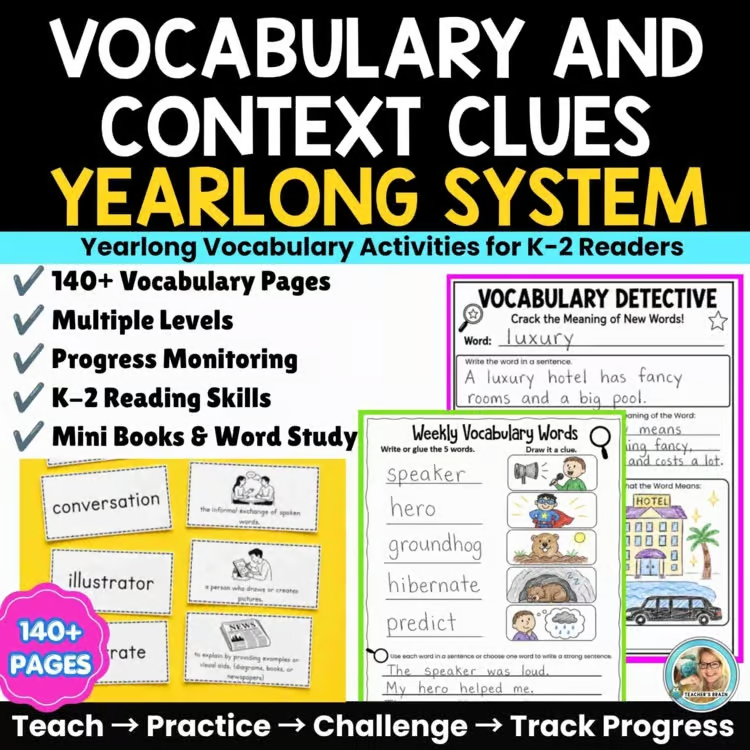
The predictable 5-day framework makes it easy to build vocabulary into your reading block while supporting Science of Reading aligned language comprehension skills. Best of all, students get meaningful, repeated practice that helps new words become part of their everyday reading and writing.
If you’re working on building strong readers from the ground up, be sure to check out my guide to phonological awareness vs. phonemic awareness. It breaks down the difference between these two important literacy skills and explains why both matter in the early grades.