Planning science for the year often sounds simple on paper… until you actually sit down to do it.
You start with good intentions. Maybe a few favorite experiments saved on Pinterest. A couple of units you know you want to teach. Then reality hits… limited time, packed schedules, unclear pacing, and the constant question of “Am I covering what I’m supposed to?”
For many kindergarten and first-grade teachers, science ends up feeling scattered instead of intentional. Not because it isn’t important, but because planning it week by week just isn’t sustainable.
The good news? Science doesn’t have to feel like something you’re always catching up on. With a clear plan and the right structure, you can teach science all year long without the stress or the last-minute scramble.
Start With a Yearlong Plan (Even a Flexible One!)
One of the easiest ways to reduce planning stress is to map out your science instruction for the entire year, before the school year even starts.
A yearlong plan helps you:
- See the big picture instead of planning day-by-day
- Ensure all major science concepts are covered
- Pace instruction in a way that makes sense for young learners
- Feel confident that nothing important is being missed
You don’t need a rigid schedule, but having a roadmap makes all the difference.
Break Science Into Manageable Units
Instead of trying to plan dozens of disconnected lessons, think in terms of units.
Strong K–1 science units typically focus on big ideas like:
- Living vs. nonliving things
- Weather and seasons
- Plants and animals
- Forces and motion
- Earth and space
When science is organized into clear units, planning becomes more manageable and instruction feels more cohesive for students.
Choose Lessons That Do the Heavy Lifting for You
The biggest time-saver? Using science lessons that are already thoughtfully planned.
A complete curriculum should include:
- Hands-on investigations
- Student-friendly science vocabulary
- Simple assessments and science notebooks
- STEM challenges and discussion opportunities
When lessons are already aligned and structured, you can spend your energy teaching, not planning.
Make Science a Routine, Not an Afterthought
Consistency is key in early elementary classrooms. Scheduling science at the same time each week (or daily, if possible) helps students build curiosity and confidence.
When science becomes part of your routine, it no longer feels like “one more thing” to fit in.
A Stress-Free Way to Teach Science All Year
If you’re looking for a way to simplify science planning, using a yearlong science curriculum can be a game-changer.
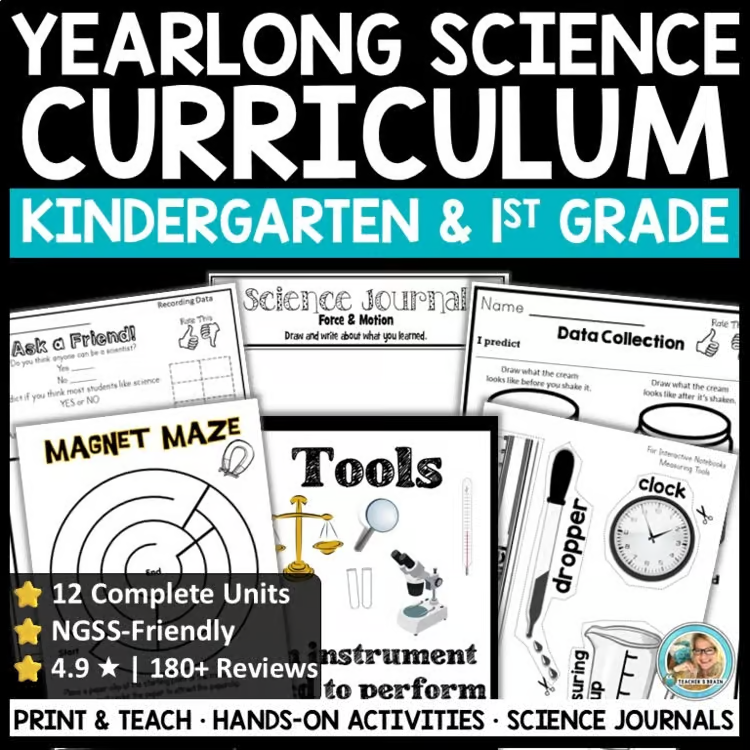
My Yearlong Science Curriculum for Kindergarten & First Grade includes 12 complete units that guide you through the entire school year. Each unit is designed with young learners in mind and includes hands-on activities, investigations, and easy-to-use lesson components, all in one place.
Instead of piecing together lessons, you can focus on what matters most: helping your students explore, ask questions, and love science.