A student reads a passage aloud, then looks at you blankly when you ask what happened. If that sounds familiar, you may be wondering which reading comprehension activities will help your students connect the words with their meaning.
After 20 years in primary classrooms, I know how much support goes into helping young readers. A manageable routine gives you space to model your thinking, listen to students, and decide what to practice next.
Start With a Short Text and a Clear Purpose
Choose a short passage or read-aloud that gives students something specific to think about. Before reading, introduce important vocabulary and briefly discuss any background information they need.
Give students a purpose, such as noticing how a character solves a problem. Keep the focus narrow enough that you can discuss it meaningfully.
For independent reading, choose text students can decode. During a read-aloud, you can support understanding of language and ideas beyond what students can read themselves.
Model Reading Comprehension Strategies Out Loud
Young readers need to hear what making sense of a text sounds like. Pause at a useful moment and explain how you connect details.
You might say, “The character packed an umbrella and noticed dark clouds. I think she expects rain because those details fit together.”
Show students what to do when meaning breaks down, too. Reread a sentence, clarify a word, or revise an earlier idea instead of pretending you understood everything immediately.
Talk Before Asking Students to Write
A written answer doesn’t always show everything a child understands. Give students time to explain an idea aloud before asking them to record it.
Try a partner prompt such as, “What was the problem, and how did the character respond?” Follow up with, “Which part helped you figure that out?”
Keep the text available so students can revisit it. Pointing to a detail and explaining its connection to an answer makes reading comprehension practice more purposeful.
Use Organizers to Make Thinking Visible
Choose an organizer that matches your lesson. A sequence chart can support retelling, while a simple space for a conclusion and supporting clues can guide an inference.
Complete an example together before asking students to work independently. Younger students can draw, dictate, or share orally while building toward written responses.
Use their answers to plan your next lesson. If students remember events but miss the problem, revisit that story element with another short text.
Build a Routine You Can Keep Using
Reading comprehension activities work best when students have opportunities to read, discuss, revisit the text, and explain their ideas.
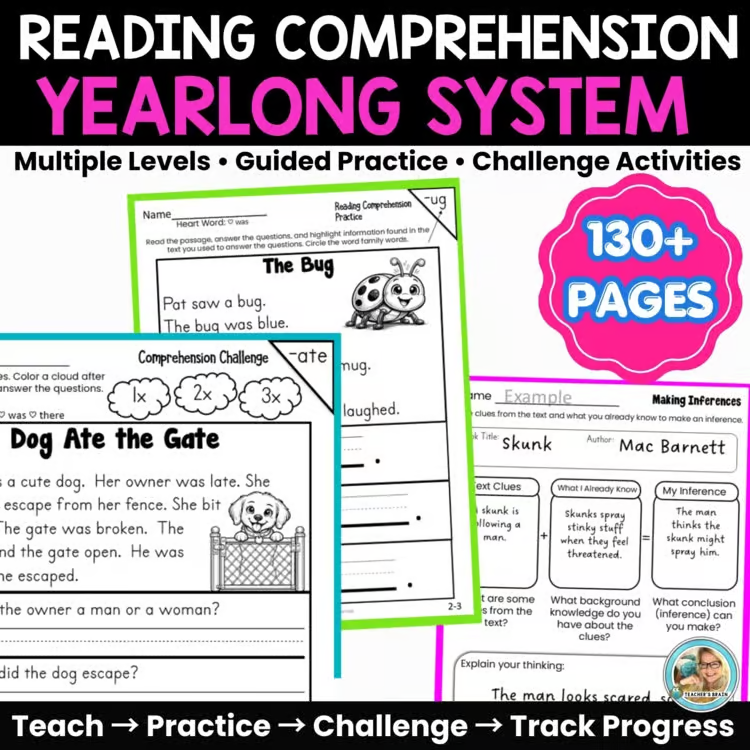
If you’d like materials to support that routine, my Reading Comprehension Yearlong System brings passages, organizers, and progress-monitoring tools together. Take a look at the preview to see how it could fit your reading instruction.
Frequently Asked Questions About the Yearlong System
The Reading Comprehension Passages & Questions Yearlong System is designed for kindergarten through second grade.
It includes 25 graphic organizers, 36 practice passages, and 36 challenge passages, along with progress-monitoring and motivation tools.
Yes. Whole-group instruction is one of the suggested uses. Choose materials that fit your lesson and the support your students need.